
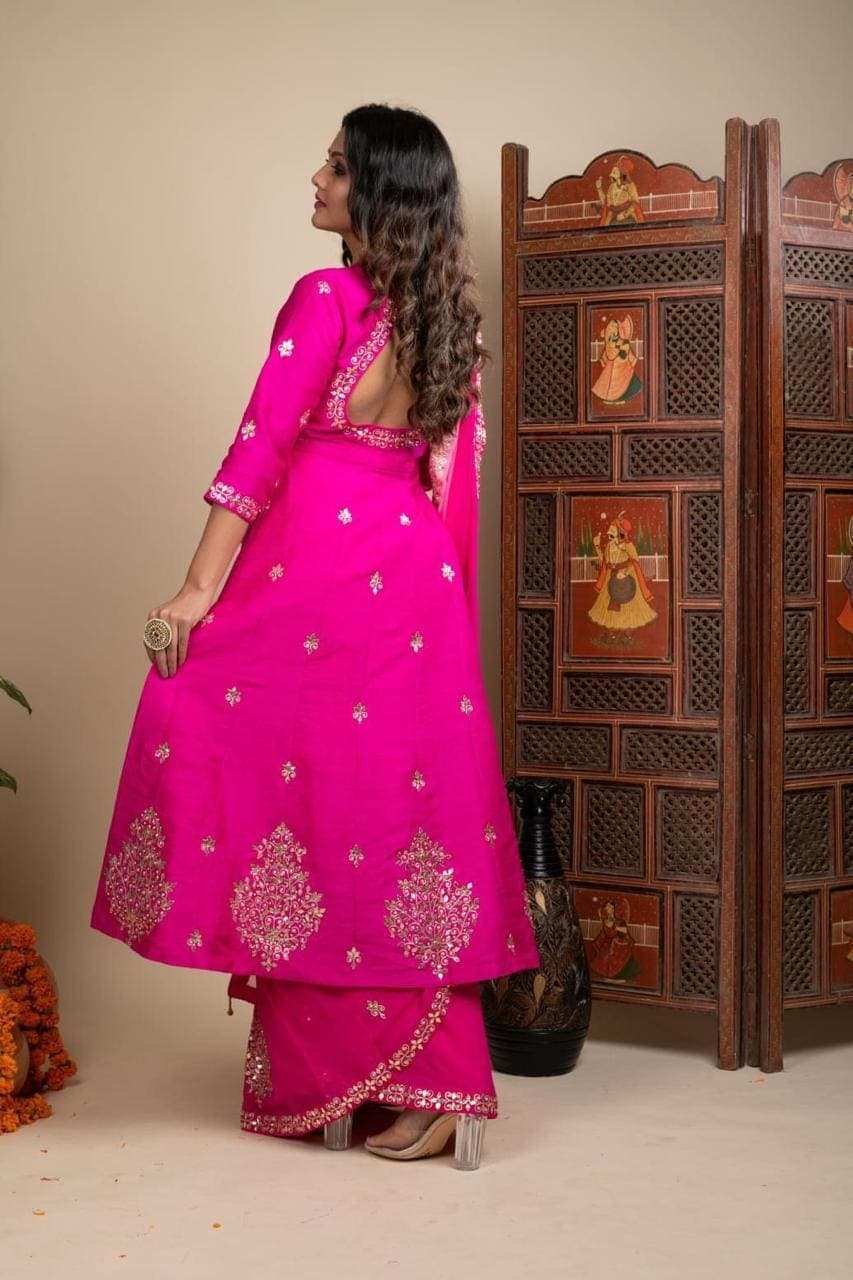
The Atelier,
set in a Jaipur haveli.
Bridal trousseaux, couture fittings, and archive styling at the Surbhi Sabnani atelier in Jaipur. By appointment only.
A city drawn before
it was built.
Jaipur was a thought before it was a place. In 1727, Maharaja Sawai Jai Singh II — astronomer-king, geometer, restless mind — commissioned a city that would obey the ancient Vastu Shastra: nine rectangular blocks for the nine divisions of the universe, a grid laid down in the desert and walled in pink sandstone.
A century and a half later, the city was painted terracotta pink — the colour of hospitality — to welcome Albert, the Prince of Wales, in 1876. The colour stayed.
What was always meant as architecture became, over time, the chromatic field on which the city's craft would be drawn.
Karkhanas,
and the keeping of crafts.
From its founding, Jaipur ran on workshops. The royal court maintained karkhanas — guild studios — where weavers, dyers, gem-cutters, and embroiderers worked under direct patronage of the Maharaja. A textile produced in one karkhana was checked against archives in another. A motif was a contract between the hand and the house.
This patronage was not generous; it was operational. The court understood that the splendour of a state was carried, quite literally, in its cloth.
A vocabulary of silver and indigo.
The hands that built the city dressed it too.
In Sanganer and Bagru, block printers carved fresh wells for indigo and madder, pressing the same wooden stamps their grandfathers had cut. In the bazaars of the old city, bandhej dyers tied fabric in tens of thousands of pinprick knots, dipping the cloth so each knot would resist the dye and become a star.
Gota patti — the lacework of flattened gold and silver — was court dress long before it was wedding dress. Zardozi, brought by the Mughals and refined by Rajput tailors, was hand-stitched on velvet and silk for durbars and processions. Meenakari, the art of enamel-on-gold, gave to jewellery what embroidery gave to cloth: a way of writing colour permanently into precious things.
Every motif carried a meaning. The peacock — hospitality. The lotus — purity. The paisley — the curve of a flame. To wear them was to carry a small sentence of the city.
What the city still teaches.
The Surbhi Sabnani Label is built inside this inheritance, not on top of it. The block prints in our archive come from the same families in Sanganer; the gota is laid down in stitches a court karigar would have recognised; the zardozi is drawn on the same wooden adda that the Mughal courts left behind.
We do not borrow from history. We continue from inside it.
The hand sets the line, and the line decides the rest.
Surbhi Sabnani Label
2/639, Jawahar Nagar
Near Geeta Mandir
Jaipur, Rajasthan 302004, India
Visits by appointment only.
An unhurried afternoon.
The Welcome
You are met at the gate, walked through the garden, and offered masala chai in the drawing room overlooking the cutting floor.
The Consultation
Surbhi or a senior karigar sits with you, takes notes, sketches silhouettes, and pulls fabric swatches and embroidery samples from the archive.
The Fitting
Measurements are taken in a private fitting room. Returning brides have their toile pinned in front of a floor-length mirror — the silence of the atelier is part of the service.
Before your visit.
- Where is the Surbhi Sabnani atelier in Jaipur?
- The atelier is at 2/639, Jawahar Nagar, Near Geeta Mandir, Jaipur, Rajasthan 302004, India.
- Do I need an appointment to visit?
- Yes. The atelier is open by appointment only. Morning consultations are preferred. Bridal fittings are typically scheduled across three to four visits in the months before the wedding.
- What does a first consultation include?
- You are met at the gate, walked through the garden, and offered masala chai. Surbhi or a senior karigar then sits with you, takes notes, sketches silhouettes, and pulls fabric swatches and embroidery samples from the archive. Measurements are taken in a private fitting room.
- What kind of couture does the house specialise in?
- Bridal trousseaux, occasion wear, and evening silhouettes — hand-finished in Jaipur. Embroideries include zardozi, gota patti, dori, sheesha, and resham, drawn by named karigars across four generations.
- Do you ship internationally?
- Yes. The house works with brides and clients worldwide. Most consultations begin in person at the Jaipur atelier; subsequent fittings can be arranged remotely or via video call where appropriate.
- What are the atelier's hours?
- The atelier is open daily, 10:00 AM to 6:00 PM. Visits are by appointment only.